
GEO services help brands be understood and cited by AI Search
Measure brand presence on AI, edit entities, improve source quality and optimize content to increase findability in Google AI, ChatGPT, Gemini, Perplexity and Copilot.
- Fixed prompt baseline
- Entity & Evidence
- Citation tracking
- SEO + GEO
What does GEO service include and which businesses is it suitable for?
GEO service, or Generative Engine Optimization, is the process of measuring and improving the ability of brands to be found, correctly understood, named or used as a source by AI systems. The actual scope includes AI visibility audit, buyer prompt research, entity, technical discoverability, answer-ready content, evidence, authority and measurement.
GEO is most suitable for businesses that have a website, professional data and basic SEO background but do not know how the brand appears in the AI search journey. GEO does not guarantee recommendations because answers vary by platform, session, location, and user context.
- Baseline is saved by prompt, platform, time, and run conditions.
- Every important claim is assigned a source, author, or verification method.
- Measuring mentions, citations, accuracy, referrals, and qualified leads instead of a location.
Four GEO packages according to brand maturity level
GEO service costs depend on the number of markets, product groups, buyer prompts, platforms to be monitored and the amount of content to be edited. Official quotes always clearly state the scope.
15 million
One time, for businesses that need to know baseline and priority space.
- 50–80 buyer prompt
- 5 AI/Search platforms
- Entity and source audit
- Roadmap 90 days
30 million/month
Minimum cycle of 3 months to fix background, important pages and evidence system.
- Baseline and tracking monthly
- Entity, schema, technical access
- 5–8 priority pages/month
- Evidence and author layer
50 million/month
Cycle from 6 months for many service groups and needs to expand citation share.
- 150–250 buyer prompt
- Content operation by cluster
- Digital PR and corroboration
- Dashboard with sprint review
From 80 million/month
For multi-market, multi-language brands or many product lines.
- Prompt set by market/persona
- Organizational level governance
- Large-scale data feed and templates
- Dedicated team
Price does not include VAT, PR/communication budget and third-party tools if incurred. SEO NHANH does not sell “AI-recommended” guarantees; The contract specifies the work, output, and measurement.
Six layers that make up a verifiable GEO service
A trustworthy GEO service project must connect accessibility, entities, content, evidence, validation sources, and measurements.
AI Visibility Baseline
Prompt set, mention, citation, sentiment, accuracy and competitors are saved according to running conditions.
Entity & Knowledge
Standardize brands, people, products, services, locations and entity relationships.
Technical Access
Crawl, rendering, robots, canonical, feed, structured data, and source accessibility.
Answer & Evidence
Clear answer, claim with source, author, methodology, update date, and limitations.
Authority Distribution
Editorial mentions, expert profiles, reviews, and third-party sources certify the brand.
Measurement & CRO
Share of model, citation share, AI referral, branded demand, lead and pipeline.
From baseline to re-measurement with the same conditions
GEO service roadmap prioritizes the gaps with the greatest impact, does not deploy a fixed checklist for every brand.
Discover
Goals, personas, markets, platforms and current data yes.
Baseline
Run prompt set, save answer, citation, accuracy and competitors.
Fix foundation
Edit technical, entity, source page and priority evidence.
Distribute
Expand corroboration, expert signals and authority accordingly appropriate.
Remeasure
Remeasure the same conditions, analyze fluctuations and close a new sprint.
Questions to clarify before implementing GEO
Answers help businesses set the right expectations about time, scope, ownership and how to evaluate the service GEO.
What is GEO?
GEO is Generative Engine Optimization, the process of optimizing content, entities, and brand signals so that AI Search engines can understand, retrieve, cite, and recommend businesses in generative responses.
Will GEO replace traditional SEO?
No. GEO inherits the foundation of technical SEO, content, entities and authority. It is difficult for an AI system to trust a website if it does not have a crawlable structure, clear source content, and consistent brand signals.
How to measure the effectiveness of GEO services?
Effectiveness is tracked through AI query coverage, brand appearance or citation rate, referral traffic from AI, branded search growth and conversions from related sessions.
Which website is suitable for implementing GEO?
B2B businesses, professional services, e-commerce, SaaS, education, and brands with a lot of consulting content are the right group. An important condition is having reliable professional data to build citation sources.
How long can a brand appear on AI Search?
There is no fixed milestone because each AI platform has a different collection and synthesis cycle. Projects are typically evaluated on a 90-day cycle, with priority given to improving the ability to be understood and cited before expanding coverage.
Send the brand and group of questions customers often ask AI.
SEO NHANH will evaluate the baseline, the source being cited, and the scope to prioritize.
GEO Services helps businesses test and improve how their brands appear in Google AI, ChatGPT, Gemini, Perplexity, and Copilot responses. This page is built for people looking for implementation units: clearly explains the scope, price list, deliverables, processes, measurements, commitment limits and appraisal criteria. GEO does not replace SEO and cannot guarantee a standalone brand recommendation model.
GEO needs to be implemented on a solid search platform. Businesses can see how SEO NHANH organizes its brand strategy, compares it with the scope overall SEO services, learn more at page introduction or submit data via page contact SEO NHANH.
What is GEO service and what do businesses actually buy?
GEO means Generative Engine Optimization: work intended to help AI answer systems find, understand and potentially cite accurate information about a brand when generating responses. A GEO engagement can begin with real buyer questions, a documented visibility baseline across agreed platforms, checks on entity and business data, improvements to answer-ready content and supporting evidence, then repeated measurement under comparable conditions. GEO complements rather than replaces SEO fundamentals. Its outputs should be a prompt set, baseline, prioritized gaps, implemented changes, source review and a report that states limitations. No agency can guarantee that an independent AI system will mention or recommend a brand in every answer.
GEO service tracks brand presence on AI
GEO coordination center tracks mentions, citations and brand accuracy. To evaluate this category, businesses need to request an output sample that hides sensitive data, the name of the person responsible, and completion standards. Good documentation should show that observed data, assumptions, and recommendations are three different layers. Separation prevents readers from mistaking forecasts for commitments, and allows internal teams to examine the rationale for each decision. In the GEO service, this category needs to have a person in charge, source data and clear acceptance conditions.

Citation does not mean endorsement. An AI system can extract websites to describe facts but not suggest brands; It is also possible to mention names based on third-party sources without providing a direct link. The report needs to separate mention, citation, recommendation context and sentiment. This classification helps businesses understand which types of presence are increasing and what actions are appropriate. In the process of providing GEO services, when evaluating ge services that track brand presence on AI, prioritize verifiability over a promise of AI visibility.
Need to check the source map instead of just looking at the summary dashboard. For each set of prompts, businesses should know which sources are commonly cited, which sources are brand-owned, which sources are third parties, and where the evidence gaps lie. Source maps turn observed data into specific backlogs for content, entities, technical and digital PR. GEO service reports should clearly reflect this requirement. That creates long-term assets instead of depending on a snapshot of results at a time.
Research buyer prompts for GEO services
Buyer prompts are grouped by research, comparison, recommendation and purchase stages. Categories only have meaning when associated with buyer prompt groups and specific assets. A change on a service page must state the question that needs to be answered, the claim that needs to be proven, the source that needs to be added, and the customer’s next action. If the report only says “optimized for AI” without specifying the URL, source, and testing criteria, the scope is not enough for acceptance. In the GEO service, this category needs to have a person in charge, source data and clear acceptance conditions.

GEO cannot be separated from SEO. Google openly states that AI platforms in Search still rely on technical foundations and useful content; structured data must match the displayed content. Websites that are blocked from crawling, have incorrect canonical content, have thin content, or lack authority are unlikely to become a stable source. Therefore, the GEO roadmap needs to use SEO data instead of building an independent system. During GEO service delivery, when evaluating research buyer prompts for geo services, prioritize verifiability over a promise of AI visibility.
At the end of each sprint, the report should answer four questions: what assets changed, what data confirmed completion, what signals moved, and what the next sprint prioritizes. If changes are not yet seen on AI, the project team must distinguish latency from quality or delivery issues. This review keeps the GEO program transparent even when outcomes have not yet appeared. GEO service reports should clearly reflect this requirement. That creates long-term assets instead of depending on a snapshot of results at a time.
GEO service deliverables
Scope connects audit, entity, content, evidence, technique, authority and measurement. The GEO service needs to record data collection conditions because AI answers are not absolutely stable. Platform, model, account type, location, language, launch date, session history and number of iterations may cause results to vary. Professional reporting describes these variables, using the same methodology from period to period and clearly noting when the platform changes. In GEO services, this category needs to have a person in charge, source data and clear acceptance conditions.

The final output must support business decisions. Share of model increases but does not create traffic, branded demand or qualified lead still needs to be explained. Part of the journey takes place in the AI interface so the attribution is not perfect; Businesses can add the question “where did you know us”, UTM when there is a referral and feedback from the sales team to create a more complete picture. During the process of providing GEO services, when evaluating geo service deliverables, prioritize verifiability over a promise of AI visibility.
Ask GEO services to demonstrate how to handle when platforms give conflicting results. A source may be cited by Perplexity but not appear in ChatGPT or Google AI. The project team needs to analyze the retrieval mechanisms, common sources, and intents on each platform, but cannot make certain inferences about internal algorithms that they cannot observe. GEO service reports should clearly reflect this requirement. That creates long-term assets instead of depending on a snapshot of results at a time.
Brand entity consistency audit
Entity audit examines the relationships between organizations, people, services, locations, and endorsements. When budgeting, differentiate between consulting fees, content production fees, development costs, tracking tools, and third-party media budgets. A low-priced GEO service package may only include audit; The full implementation package requires technical resources, editorial expertise, entities, digital PR and analytics. The scope must allow reconciliation of each item with the output. In GEO service, this item needs to have a person in charge, source data and clear acceptance conditions.

GEO services need to distinguish between brand-owned, earned, and crowdsourced sources. Each team has a different role in how the AI synthesizes answers. The official website provides standard facts; earned media independently verified; review and discussion show the experience. A good source strategy does not try to control every source but prioritizes consistency among trusted sources. During GEO service delivery, when evaluating audit brand entity consistency, prioritize verifiability over a promise of AI visibility.
Audit how the GEO service unit uses the tool. The tool helps collect large-scale data but does not replace manual review of context, accuracy and sentiment. The report should allow opening of the original response, source URL, and runtime. Aggregate indexes without accompanying raw data are difficult to use for decision making or auditing. GEO service reports should clearly reflect this requirement. That creates long-term assets instead of depending on a snapshot of results at a time.
Optimize service pages to be citation-ready
Source pages need clear answers, evidence, author, update date and conversion path. Every asset created should belong to the business: prompt set, baseline data, dashboard, content, schema, source map, tool accounts and change history. This ownership helps maintain measurement when changing personnel or vendors. It also prevents reports from only existing in closed systems where the business cannot export data for inspection. In the GEO service, this category needs to have a person in charge, source data and clear acceptance conditions.

The frequency of updates depends on the volatility of the information. Price, features, leadership, location, and policies need a faster refresh process than platform content. The GEO service should have an owner for each fact group, review date, and reference source. When detecting incorrect information in the AI answer, the project team goes back to the source map instead of just writing another correction article on the website. During the process of providing GEO services, when evaluating Optimize your service page to be citation-ready, prioritize verifiability over a promise of AI visibility.
Unify the claim review process before optimizing AI Search. Experts confirm content; legal checks sensitive statements; editor ensures easy understanding; SEO checks accessibility. GEO services should not create their own data, credentials or case studies to make their sources more attractive. Long-term reliability is more important than a mention of a name. GEO service reports should clearly reflect this requirement. That creates long-term assets rather than relying on a snapshot of results at a single point in time.
At the definition layer, the business is buying a system to diagnose and improve the information source, not buying control over the model’s answers. A reliable GEO service must clearly describe which assets are repaired, which sources are built, and which measurements are used. This framing helps leaders set the right expectations and coordinate GEO with SEO, PR, content and analytics. This is the standard that helps the GEO program stick to commercial goals while remaining true to the limits of AI Search.
How are AI visibility audits and baselines built?
An AI visibility audit starts with the questions buyers ask, not only with a brand-name search. The team groups prompts by research, comparison and selection intent; records the platforms, language, location and run conditions; then captures answers, cited sources, competitor mentions and factual accuracy. A useful baseline includes the date, prompts, platform and scoring method so it can be repeated, since responses vary by model, session and context. The results help identify entity confusion, missing answer content or weak corroborating sources before the business commits to changes. A one-off screenshot is an observation, not proof of sustained visibility or causation.
Check the accessibility of AI crawler
Technical audit checks robots, rendering, canonical, indexability, feed and server log. A GEO service item should start with a baseline and priority criteria, not with mass production. The project team needs to determine which errors are causing the AI to misunderstand the brand, which pages are influencing purchasing decisions, and which sources are influencing the responses. This order helps the budget focus on impactful gaps instead of following a new checklist that appears on the market. In GEO service, this item needs to have a person in charge, source data and clear acceptance conditions.

A buyer prompt can contain multiple intents in the same conversation. Users often move from definition to comparison, asking for risks and then asking for suggestions. The GEO service must evaluate the entire series of questions instead of just individual prompts. However, conversation sequence measurements need to be separated from the clean session baseline to avoid mixing the two methods and creating inconsistent conclusions. In the process of providing GEO services, when evaluating checking the accessibility of a crawler, prioritize verifiability over a promise of AI visibility.
Enterprises need to require an exit plan. At the end of the GEO service, the entire prompt set, historical data, source map, accounts, content and operating instructions must be handed over. Delivery milestones and data export formats should be stated in the contract. This helps internal teams continue to measure and avoid losing accumulated baselines. GEO service reports should clearly reflect this requirement. That creates long-term assets instead of depending on a snapshot of results at a time.
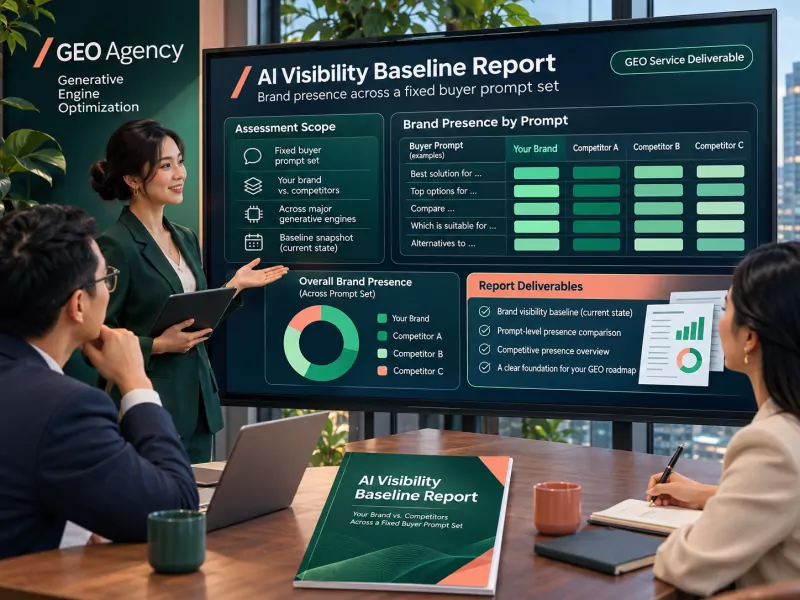
Baseline AI visibility report
Baseline compares the appearance of brands and competitors on the same set of buyer prompts. Verifiability needs to be designed in from the start. Each deliverable should have a URL, previous and next versions, reviewer, publication date, and tracking metrics. GEO services therefore do not stop at consulting; it must show that the recommendation has been translated into changes on a website, third-party source or measurement system that the business can access. In GEO service, this category needs to have a person in charge, source data and clear acceptance conditions.
For businesses in many markets, language is not just a translation. Product names, sources, competitors and regulatory requirements may vary by region. The overall GEO service needs to build separate prompt sets, entity sources and content governance for each market, then use a common reporting standard so leaders can compare without erasing local differences. During the process of providing GEO services, when evaluating baseline ai visibility report, prioritize verifiability over a promise of AI visibility.
Finally, ask under what circumstances the GEO service quote will change. Adding markets, languages, platforms, number of product groups or PR volume all increase the scope. A transparent change request mechanism protects both parties and helps leaders understand why the budget differs from the public reference package. GEO service reports should clearly reflect this requirement. That creates long-term assets instead of depending on a snapshot of results at one point in time.
Checklist of citation availability
Important Claims are labeled with data, source, method, author and date of update. Sales and customer service teams are important sources of data for GEO services. Questions, objections, and how customers describe their needs help build a buyer prompt that is more realistic than simple volume data. When front-line feedback is included in discovery, optimal content is both easy to retrieve and addresses exactly what buyers need before contacting them. In GEO service, this category needs to have a person in charge, source data and clear acceptance conditions.

The maturity level of the SEO platform directly affects the implementation speed. Websites that already have technical health, experts, original data and earned authority can quickly focus on prompt gaps. Websites with weak foundations must fix their crawl, architecture and fact sources first. GEO services should assess readiness so as not to sell the same output to every business. During the GEO service delivery process, when assessing cite source readiness checklist, prioritize verifiability over a promise of AI visibility.
Before browsing, ask: which prompts represent valuable customers, why was this platform chosen, and where will the results be saved? The answer must be clear enough that another person can run it again. If the method changes between periods, the report must note it to avoid false comparisons. This is the basic requirement for a new measurement program. GEO service reports should clearly reflect this requirement. That creates long-term assets instead of relying on a snapshot of results at a time.
Brand endorsement third-party source map
Newspapers, reviews, directories and expert profiles help reduce entity ambiguity. Longer content is not always better for AI Search. GEO service needs to determine which answer paragraphs must be concise, which claims need evidence, and which parts need depth for readers to evaluate. Heading, table, list, and summary structures are only useful when the information is accurate. Formatting cannot compensate for a source’s lack of expertise or conflicts. In GEO services, this category needs to have a person in charge, source data, and clear acceptance conditions.

The key check point is repeatability. A favorable result in one run is not enough to justify a trend; On the contrary, failure to appear once does not confirm failure. The GEO service should run multiple times according to schedule, calculate the prompt appearance rate, and save the response template. When results fluctuate, the project team needs to analyze the source, model changes, and context before drawing conclusions. In the process of providing GEO services, when evaluating a third-party source map confirming a brand, prioritize verifiability over a promise of AI visibility.
Businesses also need to know what part of the work depends on the internal team. The expert must confirm the claim; legal can review data; developer deploys schema or edits rendering; PR manages external sources. These dependencies need a person in charge and an approval deadline. If governance is ignored, a good roadmap can still stall for weeks without making changes to real assets. GEO service reports should clearly reflect this requirement. That creates long-term assets instead of depending on a snapshot of results at a time.
SEO and GEO integration model
GEO inherits the technical, content and authority foundation, and adds AI visibility measurement. Third-party sources should be selected for relevance and independence, not quantity. A relevant editorial mention can confirm expertise better than many self-created profiles. GEO services need to distinguish earned mentions, directories, reviews and sponsored content, and clearly state the relationship with the brand to avoid reducing credibility. In GEO service, this item needs to have a person in charge, source data and clear acceptance conditions.

Accuracy must be evaluated in parallel with coverage. Brands appear a lot but mischaracterizing services, locations, prices or expertise can be more harmful than not appearing at all. Accuracy review requires a standard list of facts approved by the business, an official source for each fact, and a process for handling information that is old or mistaken for an entity of the same name. In your GEO service offering, when evaluating a seo and geo integration model, prioritize verifiability over a promise of AI visibility.
Ask the vendor to clearly state what they don’t control: data collection cycles, model source selection, personalization, platform updates, and competitor behavior. A realistic commitment that focuses on work quality, output, measurement schedules and data interpretation. No unit can guarantee that an independent AI system will always recommend brands. GEO service reports should clearly reflect this requirement. That creates long-term assets instead of depending on a snapshot of results at a time.
At the baseline layer, the quality of the prompt set determines the quality of the conclusion. Prompts should reflect the persona, market, and buying situation; Don’t just ask for the brand name. Results need to be tied to the platform and running conditions. The more transparent the original data set is, the easier it is for businesses to recognize real changes instead of random fluctuations. This is the standard that helps the GEO program stick to its commercial goals while remaining true to the limits of AI Search.
AI Search optimization ranges from technical to evidence sources
AI Search optimization is often divided into six layers: technical accessibility, entity consistency, answer-ready content, verifiable evidence, off-site authority, and measurement systems. The overall GEO service sorts the processing order by baseline. A brand with the wrong entity needs to correct the entity first; A website with a clear entity but lacking reliable sources needs to prioritize evidence and corroboration. This is the part businesses need to compare before signing up for GEO services.
Customer journey from AI to qualified lead
Measure the journey from AI questions, mentions, citation sources to visits and leads. To evaluate this category, businesses need to request an output sample that hides sensitive data, the name of the person responsible, and completion standards. Good documentation should show that observed data, assumptions, and recommendations are three different layers. Separation prevents readers from mistaking forecasts for commitments, and allows internal teams to examine the rationale for each decision. In GEO service, this category needs to have a person in charge, source data and clear acceptance conditions.

Citation does not mean endorsement. An AI system can extract websites to describe facts but not suggest brands; It is also possible to mention names based on third-party sources without providing a direct link. The report needs to separate mention, citation, recommendation context and sentiment. This classification helps businesses understand which types of presence are increasing and what actions are appropriate. In the process of providing GEO services, when evaluating the customer journey from ai to qualified lead, prioritize verifiability over a promise of AI visibility.
Need to check the source map instead of just looking at the summary dashboard. For each set of prompts, businesses should know which sources are commonly cited, which sources are brand-owned, which sources are third parties, and where the evidence gaps lie. Source maps turn observed data into specific backlogs for content, entities, technical and digital PR. GEO service reports should clearly reflect this requirement. That creates long-term assets instead of depending on a snapshot of results at a time.
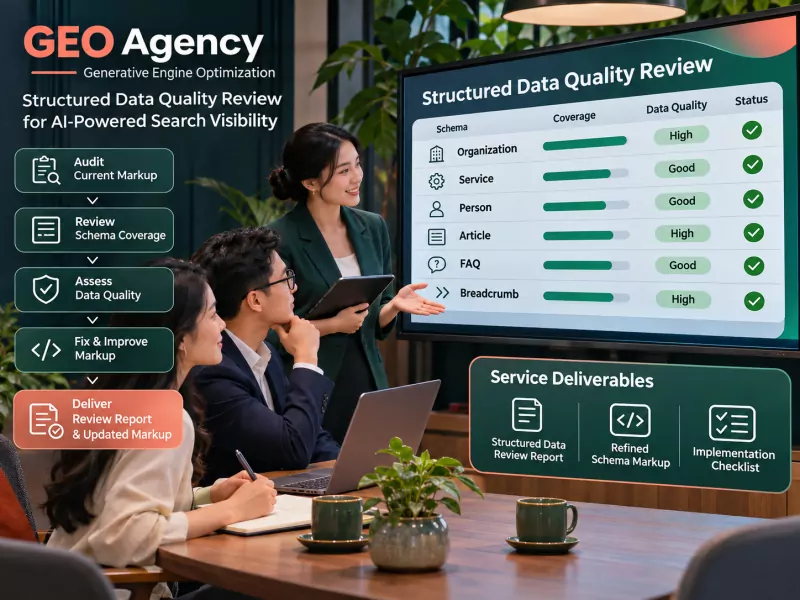
Check structured data for GEO
Schema must accurately reflect the displayed content and entity relationships on the website. Categories only have meaning when associated with buyer prompt groups and specific assets. A change on a service page must state the question that needs to be answered, the claim that needs to be proven, the source that needs to be added, and the customer’s next action. If the report only says “optimized for AI” without specifying the URL, source, and testing criteria, the scope is not enough for acceptance. In GEO service, this item needs to have a person in charge, source data and clear acceptance conditions.
GEO cannot be separated from SEO. Google openly states that AI platforms in Search still rely on technical foundations and useful content; structured data must match the displayed content. Websites that are blocked from crawling, have incorrect canonical content, have thin content, or lack authority are unlikely to become a stable source. Therefore, the GEO roadmap needs to use SEO data instead of building an independent system. During your GEO service delivery, when evaluating check structured data for geo, prioritize verifiability over a promise of AI visibility.
At the end of each sprint, the report should answer four questions: what assets changed, what data confirmed completion, what signals moved, and what the next sprint prioritizes. If changes are not yet seen on AI, the project team must distinguish latency from quality or delivery issues. This review keeps the GEO program transparent even when outcomes have not yet appeared. GEO service reports should clearly reflect this requirement. That creates long-term assets instead of depending on a snapshot of results at a time.
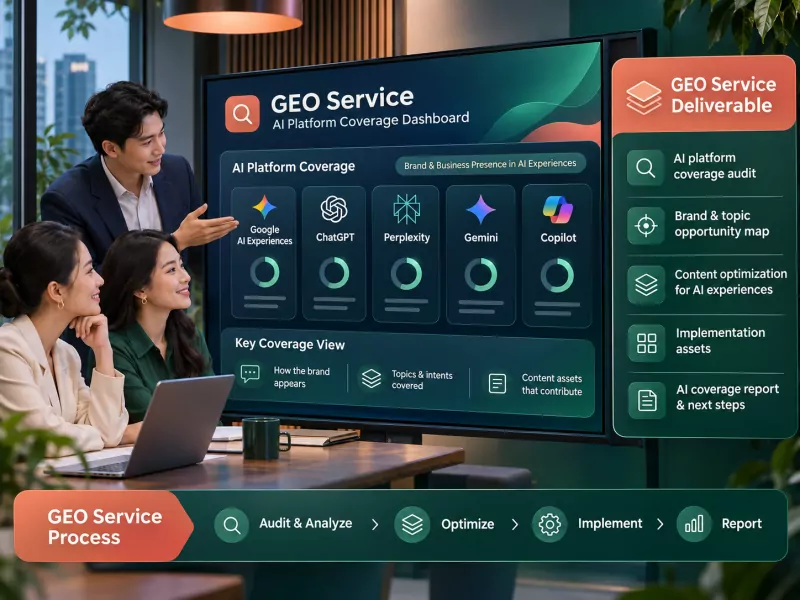
Dashboard tracks AI Search platforms
The same set of prompts is tracked across Google AI, ChatGPT, Gemini, Perplexity and Copilot. The GEO service needs to record data collection conditions because AI answers are not absolutely stable. Platform, model, account type, location, language, launch date, session history and number of iterations may cause results to vary. Professional reporting describes these variables, using the same methodology from period to period and clearly noting when the platform changes. In GEO service, this category needs to have a person in charge, source data and clear acceptance conditions.
The final output must support business decisions. Share of model increases but does not create traffic, branded demand or qualified lead still needs to be explained. Part of the journey takes place in the AI interface so the attribution is not perfect; Businesses can add the question “where did you know us”, UTM when there is a referral and feedback from the sales team to create a more complete picture. During the process of providing GEO services, when evaluating dashboard tracking ai search platforms, prioritize verifiability over a promise of AI visibility.
Ask the GEO service to demonstrate how to handle when platforms give conflicting results. A source may be cited by Perplexity but not appear in ChatGPT or Google AI. The project team needs to analyze the retrieval mechanisms, common sources, and intents on each platform, but cannot make certain inferences about internal algorithms that they cannot observe. GEO service reports should clearly reflect this requirement. That creates long-term assets instead of depending on a snapshot of results at a time.
90-day GEO service roadmap
The cycle includes baseline, background correction, priority page optimization, source expansion and re-measurement. When budgeting, differentiate between consulting fees, content production fees, development costs, tracking tools, and third-party media budgets. A low-priced GEO service package may only include audit; The full implementation package requires technical resources, editorial expertise, entities, digital PR and analytics. The scope must allow reconciliation of each item with the output. In GEO service, this category needs to have a person in charge, source data and clear acceptance conditions.

GEO service needs to distinguish between brand-owned sources, earned sources and community sources. Each team has a different role in how the AI synthesizes answers. The official website provides standard facts; earned media independently verified; review and discussion show the experience. A good source strategy does not try to control every source but prioritizes consistency among trusted sources. During your GEO service delivery, when evaluating 90-day geo services roadmap, prioritize verifiability over a promise of AI visibility.
Examine how the GEO service unit uses the tool. The tool helps collect large-scale data but does not replace manual review of context, accuracy and sentiment. The report should allow opening of the original response, source URL, and runtime. Aggregate indexes without accompanying raw data are difficult to use for decision making or auditing. GEO service reports should clearly reflect this requirement. That creates long-term assets instead of depending on a snapshot of results at a time.
GEO service implementation team
Strategy, technical, editorial, experts, digital PR and analysis coordinated by sprint. Every asset created should belong to the business: prompt set, baseline data, dashboard, content, schema, source map, tool accounts and change history. This ownership helps maintain measurement when changing personnel or vendors. It also prevents reports from only existing in closed systems where the business cannot export data for inspection. In GEO services, this category needs to have a person in charge, source data and clear acceptance conditions.

The frequency of updates depends on the fluctuation of information. Price, features, leadership, location, and policies need a faster refresh process than platform content. The GEO service should have an owner for each fact group, review date, and reference source. When detecting incorrect information in the AI answer, the project team goes back to the source map instead of just writing another correction article on the website. During the process of providing GEO services, when evaluating geo service deployment team, prioritize verifiability over a promise of AI visibility.
Unify the claim approval process before optimizing AI Search. Experts confirm content; legal checks sensitive statements; editor ensures easy understanding; SEO checks accessibility. GEO services should not create their own data, credentials or case studies to make their sources more attractive. Long-term reliability is more important than a mention of a name. GEO service reports should clearly reflect this requirement. That creates long-term assets rather than depending on a single snapshot of results at a point in time.
At the implementation layer, prioritization starts with errors that hinder the ability to be understood and trusted. Wrong entities, conflicting sources, and important pages lacking evidence often need to be addressed before producing more articles. GEO services should reuse existing expert data, add authors/reviewers and publish methods instead of just changing the words according to a formula. This is the standard that helps the GEO program stick to its commercial goals while remaining true to the limits of AI Search.
90-day GEO process and coordination mechanism
A realistic Generative Engine Optimization cycle takes enough time to establish baseline data, fix priority assets, distribute power, and remeasure. During the first 90 days, businesses should not expect every platform to reflect changes at the same time. The right goal is to create a clear source system, reduce misinformation, increase citation readiness, and establish a steady measurement cadence for subsequent cycles. This is the part businesses need to compare before signing for GEO services.
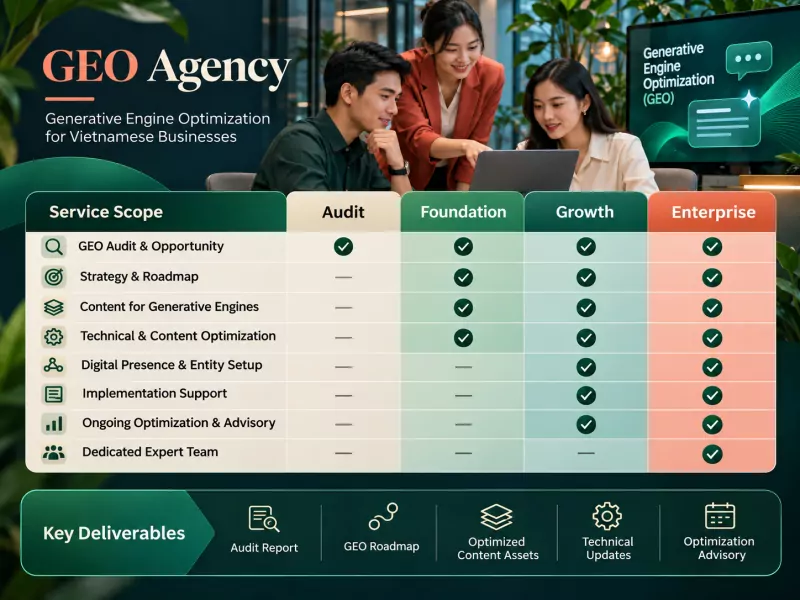
Compare the scope of GEO service packages
The four packages Audit, Foundation, Growth and Enterprise meet different maturity levels. A GEO service item should start with a baseline and priority criteria, not with mass production. The project team needs to determine which errors are causing the AI to misunderstand the brand, which pages are influencing purchasing decisions, and which sources are influencing the responses. This order helps the budget focus on impactful gaps instead of following a new checklist that appears on the market. In GEO service, this category needs to have a person in charge, source data and clear acceptance conditions.
A buyer prompt can contain multiple intentions in the same conversation. Users often move from definition to comparison, asking for risks and then asking for suggestions. The GEO service must evaluate the entire series of questions instead of just individual prompts. However, conversation sequence measurements need to be separated from the clean session baseline to avoid mixing the two methods and creating inconsistent conclusions. In the process of providing GEO services, when evaluating comparing the scope of geo service packages, prioritize verifiability over a promise of AI visibility.
Enterprises need to require an exit plan. At the end of the GEO service, the entire prompt set, historical data, source map, accounts, content and operating instructions must be handed over. Delivery milestones and data export formats should be stated in the contract. This helps internal teams continue to measure and avoid losing accumulated baselines. GEO service reports should clearly reflect this requirement. That creates long-term assets instead of depending on a snapshot of results at one point in time.
GEO content update process
Prioritize commercial pages, definitions, comparisons, original data and expert review rounds. Verifiability needs to be designed in from the start. Each deliverable should have a URL, previous and next versions, reviewer, publication date, and tracking metrics. GEO services therefore do not stop at consulting; it must show that the recommendation has been translated into changes on a website, third-party source or measurement system that the business can access. In the GEO service, this category needs to have a person in charge, source data and clear acceptance conditions.

For businesses with many markets, language is more than just translation. Product names, sources, competitors and regulatory requirements may vary by region. The overall GEO service needs to build separate prompt sets, entity sources and content governance for each market, then use a common reporting standard so leaders can compare without erasing local differences. During GEO service delivery, when evaluating geo content update process, prioritize verifiability over a promise of AI visibility.
Finally, ask under what circumstances the GEO service quote will change. Adding markets, languages, platforms, number of product groups or PR volume all increase the scope. A transparent change request mechanism protects both parties and helps leaders understand why the budget differs from the public reference package. GEO service reports should clearly reflect this requirement. That creates a long-term asset instead of depending on a snapshot of results at a time.
GEO Service Contract Scope
The contract outlines the work, exclusions, responsibilities, approval times, and data ownership. Sales and customer service teams are important sources of data for GEO services. Questions, objections, and how customers describe their needs help build a buyer prompt that is more realistic than simple volume data. When front-line feedback is included in discovery, optimal content is both easy to retrieve and addresses exactly what buyers need before contacting them. In GEO services, this item needs to have a person in charge, source data and clear acceptance conditions.

The maturity level of the SEO platform directly affects the speed of implementation. Websites that already have technical health, experts, original data and earned authority can quickly focus on prompt gaps. Websites with weak foundations must fix their crawl, architecture and fact sources first. GEO services should assess readiness so as not to sell the same output to every business. During the GEO service delivery process, when evaluating the scope of the geo service contract, prioritize verifiability over a promise of AI visibility.
Before browsing, ask: which prompts represent valuable customer experiences, why was this platform chosen, and where will the results be stored? The answer must be clear enough that another person can run it again. If the method changes between periods, the report must note it to avoid false comparisons. This is the basic requirement for a new measurement program. GEO service reports should clearly reflect this requirement. That creates long-term assets instead of depending on a snapshot of results at a time.
Constant buyer prompt testing process
Each run saves the platform, model, date, location, session type, and number of iterations. Longer content is not always better for AI Search. GEO service needs to determine which answer paragraphs must be concise, which claims need evidence, and which parts need depth for readers to evaluate. Heading, table, list and summary structures are only useful when the information is accurate. Formatting cannot compensate for a source’s lack of expertise or conflicts. In the GEO service, this item needs to have a person in charge, source data, and clear acceptance conditions.

The key checkpoint is repeatability. A favorable result in one run is not enough to justify a trend; On the contrary, failure to appear once does not confirm failure. The GEO service should run multiple times according to the schedule, calculate the occurrence rate on the prompt set, and save the response template. When results fluctuate, the project team needs to analyze the source, model changes, and context before drawing conclusions. During your GEO service delivery, when evaluating a fixed buyer prompt testing process, prioritize verifiability over a promise of AI visibility.
Businesses also need to know which parts depend on internal teams. The expert must confirm the claim; legal can review data; developer deploys schema or edits rendering; PR manages external sources. These dependencies need a person in charge and an approval deadline. If governance is ignored, a good roadmap can still stall for weeks without making changes to real assets. GEO service reports should clearly reflect this requirement. That creates long-term assets instead of depending on a snapshot of results at a time.
Check brand information accuracy on AI
Accuracy review detects information that is wrong, old, the wrong entity or lacking context. Third-party sources should be selected for relevance and independence, not quantity. A relevant editorial mention can confirm expertise better than many self-created profiles. GEO services need to distinguish earned mentions, directories, reviews and sponsored content, and clearly state the relationship with the brand to avoid reducing credibility. In GEO service, this category needs to have a person in charge, source data and clear acceptance conditions.

Accuracy must be evaluated in parallel with coverage. Brands appear a lot but mischaracterizing services, locations, prices or expertise can be more harmful than not appearing at all. Accuracy review requires a standard list of facts approved by the business, an official source for each fact, and a process for handling information that is old or mistaken for an entity of the same name. In the process of providing GEO services, when evaluating checking the accuracy of brand information on ai, prioritize verifiability over a promise of AI visibility.
Ask the provider to clearly state what they do not control: data collection cycles, model source selection, personalization, platform updates, and competitor behavior. A realistic commitment that focuses on work quality, output, measurement schedules and data interpretation. No unit can guarantee that an independent AI system will always recommend brands. GEO service reports should clearly reflect this requirement. That creates long-term assets instead of depending on a snapshot of results at one point in time.
At the operations layer, governance determines speed. GEO touches on brand facts, legal claims, product data, experts and press sources, so it requires approval from many parties. The 90-day roadmap must have dependencies, SLAs and escalations. When roles are clear, the project team can react quickly to miscommunication or platform changes. This is the standard that helps the GEO program stick to its commercial goals while remaining true to the limits of AI Search.
Measuring GEO effectiveness with mentions, citations and business results
GEO does not have one fixed ranking position equivalent to a traditional blue-link result. Track a representative prompt set repeatedly under documented conditions, then assess brand mentions, citations, factual accuracy, sources used, competitor presence and attributable AI referrals or leads. One appearance does not prove a trend, and one absence does not prove failure. Reporting should separate observed results from hypotheses, state platform limitations and connect visibility changes to business objectives. Keep the prompts, dates and run settings consistent where possible; when a platform changes, record the change rather than comparing unlike results. The goal is reliable learning and improved discoverability, not a guaranteed recommendation from an AI system.
Analyzing the variability of AI answers
Multiple run results help distinguish temporary mentions from more reliable trends. To evaluate this category, businesses need to request an output sample that hides sensitive data, the name of the person responsible, and completion standards. Good documentation should show that observed data, assumptions, and recommendations are three different layers. Separation prevents readers from mistaking forecasts for commitments, and allows internal teams to examine the rationale for each decision. In the GEO service, this category needs to have a person in charge, source data and clear acceptance conditions.

Citation does not mean endorsement. An AI system can extract websites to describe facts but not suggest brands; It is also possible to mention names based on third-party sources without providing a direct link. The report needs to separate mention, citation, recommendation context and sentiment. This classification helps businesses understand which types of presence are increasing and what actions are appropriate. During GEO service delivery, when evaluating ai answer variability analysis, prioritize verifiability over a promise of AI visibility.
Need to check the source map instead of just looking at the summary dashboard. For each set of prompts, businesses should know which sources are commonly cited, which sources are brand-owned, which sources are third parties, and where the evidence gaps lie. Source maps turn observed data into specific backlogs for content, entities, technical and digital PR. GEO service reports should clearly reflect this requirement. That creates long-term assets instead of depending on a snapshot of results at a time.
Digital PR supports authority for GEO
Expert commentary and earned media create a source of validation beyond the brand website. Categories only have meaning when associated with buyer prompt groups and specific assets. A change on a service page must state the question that needs to be answered, the claim that needs to be proven, the source that needs to be added, and the customer’s next action. If the report only says “optimized for AI” without specifying the URL, source, and testing criteria, the scope is not enough for acceptance. In GEO service, this category needs to have a person in charge, source data and clear acceptance conditions.

GEO cannot be separated from SEO. Google openly states that AI platforms in Search still rely on technical foundations and useful content; structured data must match the displayed content. Websites that are blocked from crawling, have incorrect canonical content, have thin content, or lack authority are unlikely to become a stable source. Therefore, the GEO roadmap needs to use SEO data instead of building an independent system. During GEO service delivery, when evaluating digital PR support for geo authority, prioritize verifiability over a promise of AI visibility.
At the end of each sprint, the report should answer four questions: what assets changed, what data confirmed completion, what signals moved, and what the next sprint prioritizes. If changes are not yet seen on AI, the project team must distinguish latency from quality or delivery issues. This review keeps the GEO program transparent even when outcomes have not yet appeared. GEO service reports should clearly reflect this requirement. That creates long-term assets instead of depending on a snapshot of results at a time.
Measuring AI referrals and conversions
Track from AI platform to landing page, form, qualified lead and pipeline in CRM. The GEO service needs to record data collection conditions because AI answers are not absolutely stable. Platform, model, account type, location, language, launch date, session history and number of iterations may cause results to vary. Professional reporting describes these variables, using the same methodology from period to period and clearly noting when the platform changes. In GEO service, this category needs to have a person in charge, source data and clear acceptance conditions.

The final output must support business decisions. Share of model increases but does not create traffic, branded demand or qualified lead still needs to be explained. Part of the journey takes place in the AI interface so the attribution is not perfect; Businesses can add the question “where did you know us”, UTM when there is a referral and feedback from the sales team to create a more complete picture. In the process of providing GEO services, when evaluating measure referrals and conversions, prioritize verifiability over a promise of AI visibility.
Ask GEO services to demonstrate how to handle when platforms give conflicting results. A source may be cited by Perplexity but not appear in ChatGPT or Google AI. The project team needs to analyze the retrieval mechanisms, common sources, and intents on each platform, but cannot make certain inferences about internal algorithms that they cannot observe. GEO service reports should clearly reflect this requirement. That creates a lasting asset rather than relying on a snapshot of results at a single point in time.
Original research assets powered by AI citation
Research should disclose methods, samples, limitations, results, and verifiable data. When budgeting, differentiate between consulting fees, content production fees, development costs, tracking tools, and third-party media budgets. A low-priced GEO service package may only include audit; The full implementation package requires technical resources, editorial expertise, entities, digital PR and analytics. The scope must allow reconciliation of each item with the output. In GEO service, this item needs to have a person in charge, source data and clear acceptance conditions.

GEO services should differentiate between brand-owned, earned, and crowdsourced. Each team has a different role in how the AI synthesizes answers. The official website provides standard facts; earned media independently verified; review and discussion show the experience. A good source strategy does not try to control every source but prioritizes consistency among trusted sources. In your GEO service delivery, when evaluating original research assets that support ai citation, prioritize verifiability over a promise of AI visibility.
Examine how the GEO service unit uses the tool. The tool helps collect large-scale data but does not replace manual review of context, accuracy and sentiment. The report should allow opening of the original response, source URL, and runtime. Aggregate indexes without accompanying raw data are difficult to use for decision making or auditing. GEO service reports should clearly reflect this requirement. That creates long-term assets instead of depending on a snapshot of results at a time.
Trace citation sources in AI answers
Citation provenance connects the answer with the source URL, claim, evidence and person in charge. Every asset created should belong to the business: prompt set, baseline data, dashboard, content, schema, source map, tool accounts and change history. This ownership helps maintain measurement when changing personnel or vendors. It also prevents reports from only existing in closed systems where the business cannot export data for inspection. In the GEO service, this category needs to have a person in charge, source data and clear acceptance conditions.

The frequency of updates depends on the volatility of the information. Price, features, leadership, location, and policies need a faster refresh process than platform content. The GEO service should have an owner for each fact group, review date, and reference source. When detecting incorrect information in the AI answer, the project team goes back to the source map instead of just writing another correction article on the website. During the process of providing GEO services, when evaluating trace the source cited in the answer ai, prioritize verifiability over a promise of AI visibility.
Unify the claim approval process before optimizing AI Search. Experts confirm content; legal checks sensitive statements; editor ensures easy understanding; SEO checks accessibility. GEO services should not create their own data, credentials or case studies to make their sources more attractive. Long-term reliability is more important than a mention of a name. GEO service reports should clearly reflect this requirement. That creates long-term assets rather than relying on a snapshot of results at a single point in time.
At the measurement layer, dashboards must hold both raw data and aggregated methods. The occurrence rate needs to include sample size, number of iterations and model change annotation. Citation shares need to be traceable to the source URL. AI referrals and leads need to be placed next to branded search to identify indirect effects without overstating cause and effect. This is the standard that helps the GEO program stick to its commercial goals while still staying true to the limits of AI Search.
GEO service quotes and how to control risks
GEO service quotes on the market are still different because Generative Engine Optimization does not have a uniform scope. Businesses need to ask which platforms the supplier is monitoring, how the buyer prompt is selected, whether running conditions are saved, which assets they edit, and how they measure conversions. Eliminate suggestions that guarantee the AI will recommend brands, hide methods, or use a few convenient photos as the only evidence. This is the part businesses need to compare before signing up for GEO services.
Dashboard share of model
Compare the appearance rate of brands and competitors on a fixed prompt with reliability notes. A GEO service item should start with a baseline and priority criteria, not with mass production. The project team needs to determine which errors are causing the AI to misunderstand the brand, which pages are influencing purchasing decisions, and which sources are influencing the responses. This order helps the budget focus on impactful gaps instead of following a new checklist that appears on the market. In GEO service, this category needs to have a person in charge, source data and clear acceptance conditions.
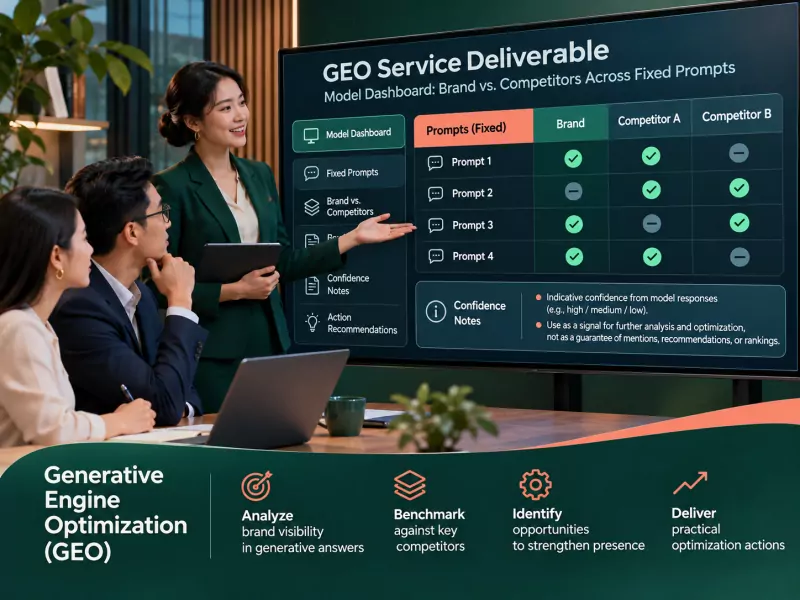
A buyer prompt can contain multiple intents in the same conversation. Users often move from definition to comparison, asking for risks and then asking for suggestions. The GEO service must evaluate the entire series of questions instead of just individual prompts. However, conversation sequence measurements need to be separated from the clean session baseline to avoid mixing the two methods and creating inconsistent conclusions. During GEO service delivery, when evaluating dashboard share of model, prioritize verifiability over a promise of AI visibility.
Businesses need to require an exit plan. At the end of the GEO service, the entire prompt set, historical data, source map, accounts, content and operating instructions must be handed over. Delivery milestones and data export formats should be stated in the contract. This helps internal teams continue to measure and avoid losing accumulated baselines. GEO service reports should clearly reflect this requirement. That creates long-term assets instead of depending on a snapshot of results at a time.
Author and expert profile system
Credentials, biographies, reviewed content and off-site sources reinforce expertise. Verifiability needs to be designed in from the start. Each deliverable should have a URL, previous and next versions, reviewer, publication date, and tracking metrics. GEO services therefore do not stop at consulting; it must show that the recommendation has been translated into changes on a website, third-party source or measurement system that the business can access. In GEO services, this category needs to have a person in charge, source data and clear acceptance conditions.

For businesses with many markets, language is not just a translation. Product names, sources, competitors and regulatory requirements may vary by region. The overall GEO service needs to build separate prompt sets, entity sources and content governance for each market, then use a common reporting standard so leaders can compare without erasing local differences. In providing GEO services, when evaluating author and expert profile systems, prioritize verifiability over a promise of AI visibility.
Finally, ask under what circumstances the GEO service quote will change. Adding markets, languages, platforms, number of product groups or PR volume all increase the scope. A transparent change request mechanism protects both parties and helps leaders understand why the budget differs from the public reference package. GEO service reports should clearly reflect this requirement. That creates long-term assets instead of depending on a snapshot of results at a time.
GEO project governance mechanism
Brand, legal, SEO, content, PR and analytics have clear approval roles. Sales and customer service teams are important sources of data for GEO services. Questions, objections, and how customers describe their needs help build a buyer prompt that is more realistic than simple volume data. When front-line feedback is included in discovery, optimal content is both easy to retrieve and addresses exactly what buyers need before contacting them. In GEO services, this category needs to have a person in charge, source data and clear approval conditions.
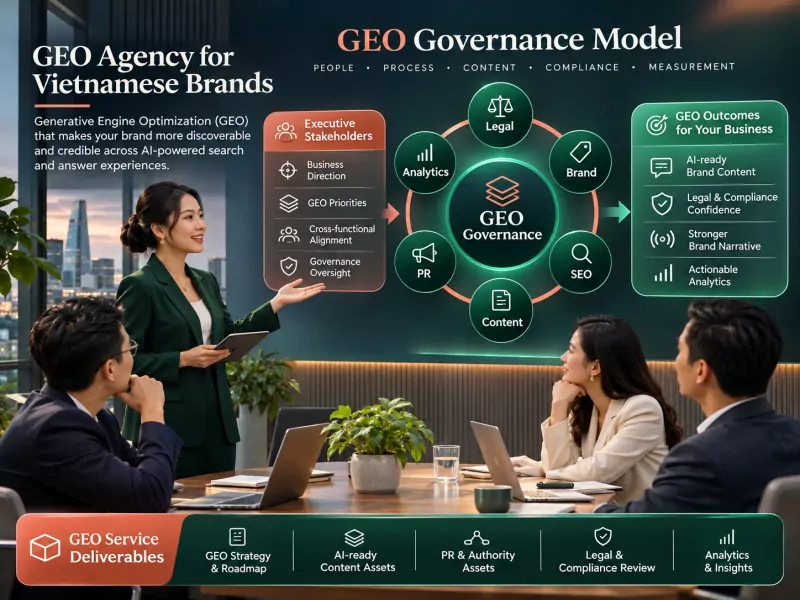
The maturity level of the SEO platform directly affects the speed of implementation. Websites that already have technical health, experts, original data and earned authority can quickly focus on prompt gaps. Websites with weak foundations must fix their crawl, architecture and fact sources first. GEO services should assess readiness so as not to sell the same output to every business. During GEO service delivery, when evaluating geo project governance mechanisms, prioritize verifiability over a promise of AI visibility.
Before browsing, ask: which prompts represent valuable customers, why was this platform chosen, and where will the results be saved? The answer must be clear enough that another person can run it again. If the method changes between periods, the report must note it to avoid false comparisons. This is the basic requirement for a new measurement program. GEO service reports should clearly reflect this requirement. That creates long-term assets instead of depending on a snapshot of results at one point in time.
GEO Services Risk Categories
Manage hallucinations, prompt changes, personalization, attribution and platform changes. Longer content is not always better for AI Search. GEO service needs to determine which answer paragraphs must be concise, which claims need evidence, and which parts need depth for readers to evaluate. Heading, table, list and summary structures are only useful when the information is accurate. Formatting cannot compensate for a source’s lack of expertise or conflicts. In GEO services, this category needs to have a person in charge, source data, and clear acceptance conditions.
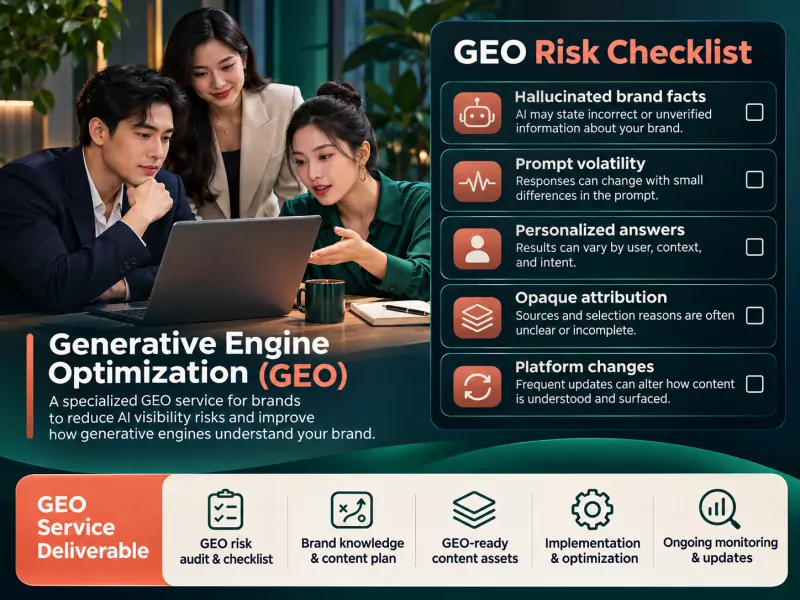
The important check point is repeatability. A favorable result in one run is not enough to justify a trend; On the contrary, failure to appear once does not confirm failure. The GEO service should run multiple times according to the schedule, calculate the occurrence rate on the prompt set, and save the response template. When results fluctuate, the project team needs to analyze the source, model changes, and context before drawing conclusions. During the process of providing GEO services, when evaluating geo services’ risk profile, prioritize verifiability over a promise of AI visibility.
Businesses also need to know which parts of the work depend on internal teams. The expert must confirm the claim; legal can review data; developer deploys schema or edits rendering; PR manages external sources. These dependencies need a person in charge and an approval deadline. If governance is ignored, a good roadmap can still stall for weeks without making changes to real assets. GEO service reports should clearly reflect this requirement. That creates long-term assets instead of depending on a snapshot of results at one point in time.
GEO service proposal handover
The final proposal unifies the scope, timeline, measurements, responsibilities and launch steps. Third-party sources should be selected for relevance and independence, not quantity. A relevant editorial mention can confirm expertise better than many self-created profiles. GEO services need to distinguish earned mentions, directories, reviews and sponsored content, and clearly state the relationship with the brand to avoid reducing credibility. In GEO service, this item needs to have a person in charge, source data and clear acceptance conditions.

Accuracy must be evaluated in parallel with coverage. Brands appear a lot but mischaracterizing services, locations, prices or expertise can be more harmful than not appearing at all. Accuracy review requires a standard list of facts approved by the business, an official source for each fact, and a process for handling information that is old or mistaken for an entity of the same name. During the GEO service delivery process, when evaluating geo service proposal delivery, prioritize verifiability over a promise of AI visibility.
Ask the vendor to clearly state what they do not control: data collection cycles, model source selection, personalization, platform updates, and competitor behavior. A realistic commitment that focuses on work quality, output, measurement schedules and data interpretation. No unit can guarantee that an independent AI system will always recommend brands. GEO service reports should clearly reflect this requirement. That creates long-term assets instead of depending on a snapshot of results at one point in time.
At the partner selection layer, prioritize a unit that knows the limits. Good vendors don’t make llms.txt, schema or a tracking tool the only “secret sauce”. They connect technical SEO, content, entities, evidence, earned authority and measurement; data handover; At the same time, adjust the scope according to the maturity level of the business. This is the standard that helps the GEO program stick to its commercial goals while remaining true to the limits of AI Search.
GEO services: common questions
How is GEO different from SEO? Does GEO replace SEO?
SEO focuses on helping pages be crawled, indexed, understood and ranked in search. GEO commonly describes measuring and improving whether generative systems can retrieve, understand or cite a brand and its content. The disciplines share foundations such as useful content, accurate information, accessibility and trust; GEO adds conversational query research, corroborating sources and monitoring of AI answers. GEO does not replace SEO. Google says there is no special schema that guarantees inclusion in AI Overviews.
What work and deliverables can a GEO service include?
A GEO engagement may include a representative buyer-prompt set, an AI-visibility baseline, accessibility and entity checks, content and evidence review, prioritized page improvements, relevant external-source review and repeat measurement. Deliverables should document platforms, language, location, run date, prompts, scoring criteria, edited URLs, responsibilities and data limitations. Scope may stop at an audit or include implementation; confirm exactly which before purchase rather than relying on a broad claim such as “AI optimization.”
Can a GEO service guarantee citations from ChatGPT or Google AI?
No. A provider does not control a model, its retrieval set, personalization, corroborating sources or platform changes, so it cannot guarantee a brand will be mentioned or cited in every answer. Responsible work improves accessibility, factual clarity, evidence and relevant corroboration, then measures a repeatable prompt set under documented conditions. Contracts should define work, deliverables, measurement cadence and reporting, not turn a platform-dependent outcome into a certainty.
Conclusion: start GEO with a verifiable baseline
Businesses should start with an AI visibility audit with a clear set of buyer prompts, running conditions and source map. A responsible GEO service prioritizes technical access, entities, answer-ready content, evidence, authority and measurement. The official GEO service quote clearly states the platform, number of prompts, number of pages, output, responsibilities of both parties and evaluation method. Please submit your website, market, product group and frequently asked questions by customers to receive the appropriate GEO service scope.